
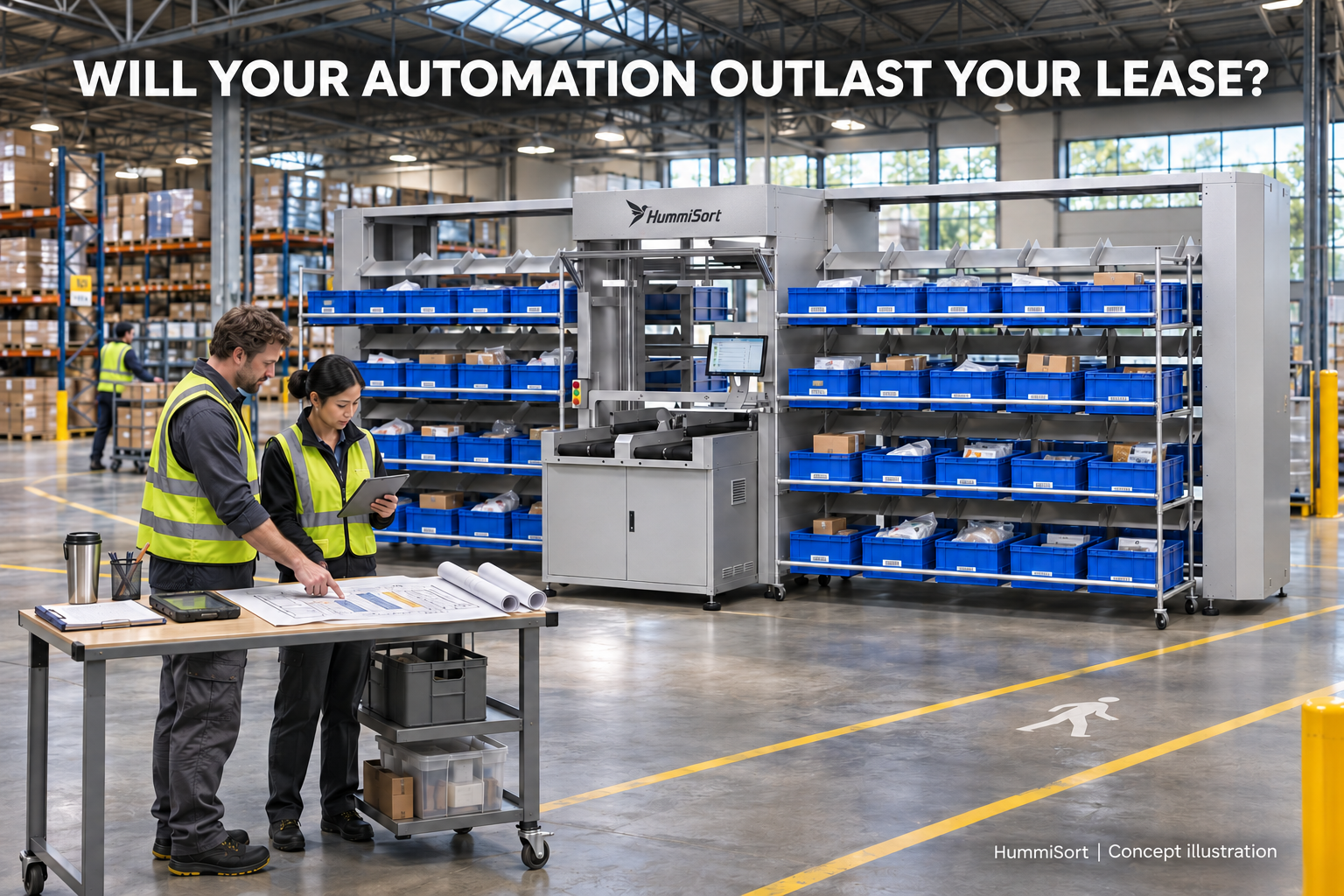
Your automation has a five-year payback.
Your warehouse lease has three years left.
Which number should decide the investment?
Consider a hypothetical 3PL operation: the equipment should pay back in five years, the building lease expires in three, and the customer contract ends in two.
A faster machine does not resolve that mismatch.
Before comparing throughput, put three dates on the same page:
- Customer contract expiry
- Warehouse lease expiry
- Expected investment payback
Then ask what happens if one of them changes.
Can the equipment serve another customer?
What can move to a new building?
Who pays for dismantling, transport, recommissioning and lost operating time?
What happens to site-specific software and interfaces?
A longer commitment can support investment. But flexibility also has value. Neither “always lease longer” nor “always buy modular” is a complete answer.
Ask suppliers for a relocation scope alongside the installation scope. Separate reusable assets from site-specific work.
A put wall or conveyor should be evaluated as part of that operating plan—not just as a rate on a quotation.
If your customer contract lasted two years, what would make you comfortable buying automation with a four-year payback?