
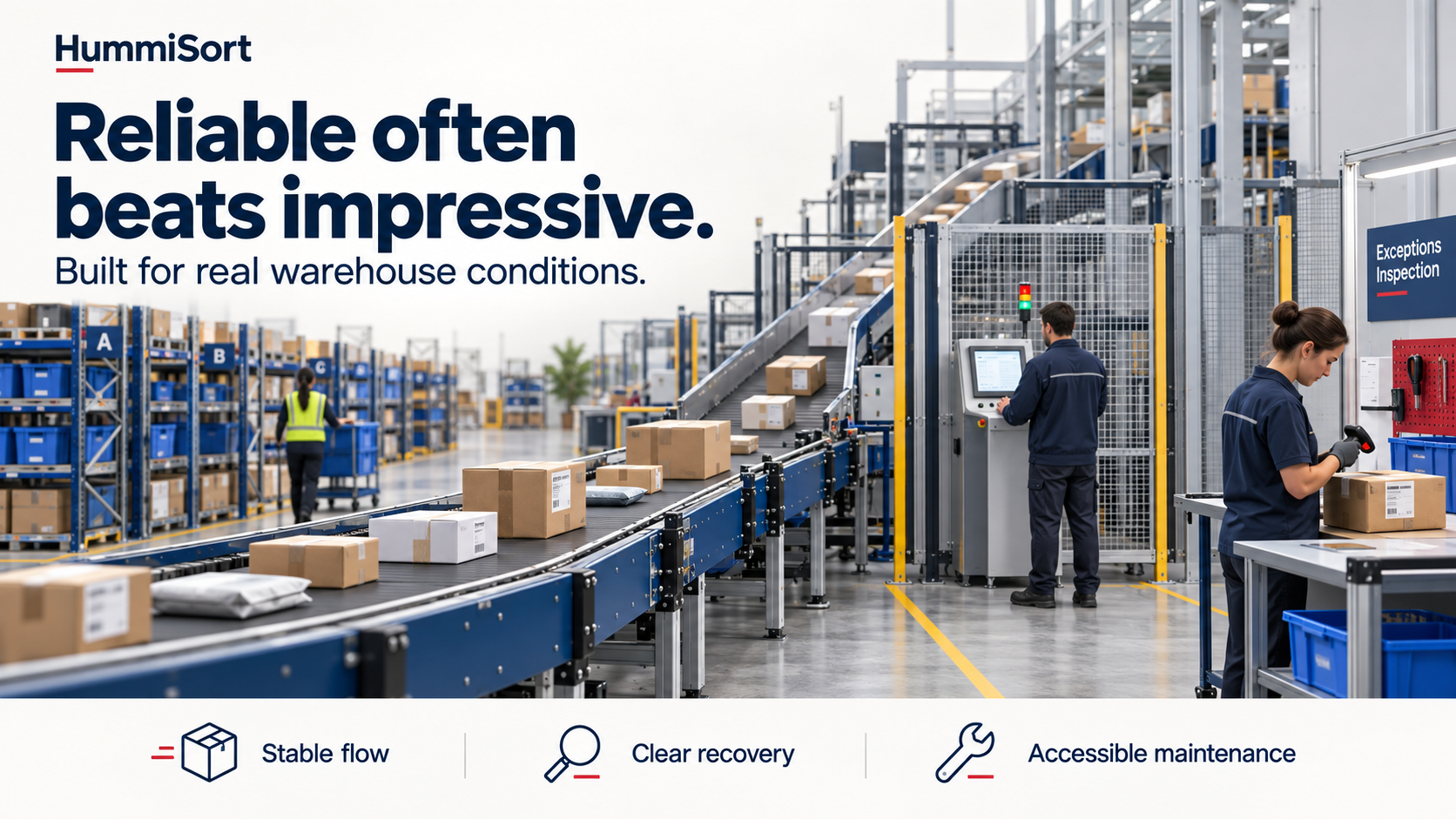
Warehouse automation is often judged by demos: how fast it moves, how intelligent it looks, and how many features it lists.
But daily operations ask different questions:
- Does it handle real SKU variation, damaged labels and uneven flow?
- Does it remain stable during peak volume and shift changes?
- Can operators understand and recover from faults without waiting for one specialist?
- Can maintenance teams access the system safely?
- Does performance remain predictable after months of use?
The gap between a demonstration and a real warehouse is where many investment decisions are tested. A technology may look excellent in a controlled video but create extra work when the order profile changes, the data is incomplete or an exception appears.
A simple system that supports disciplined flow can create more value than a complex system that is difficult to operate. The most useful proof is usually a combination of a live reference site, representative data and a clear plan for exceptions, maintenance and future expansion.
When selecting warehouse technology, what proof do you trust most: a demo, a reference site, or long-term operating data?
#WarehouseTechnology #Automation #Intralogistics #Fulfillment #OperationalExcellence