Your warehouse has two inventory flows. Most companies carefully design the forward flow but treat the reverse flow as a separate customer-service problem. That is where margin quietly disappears.
A return can have several outcomes
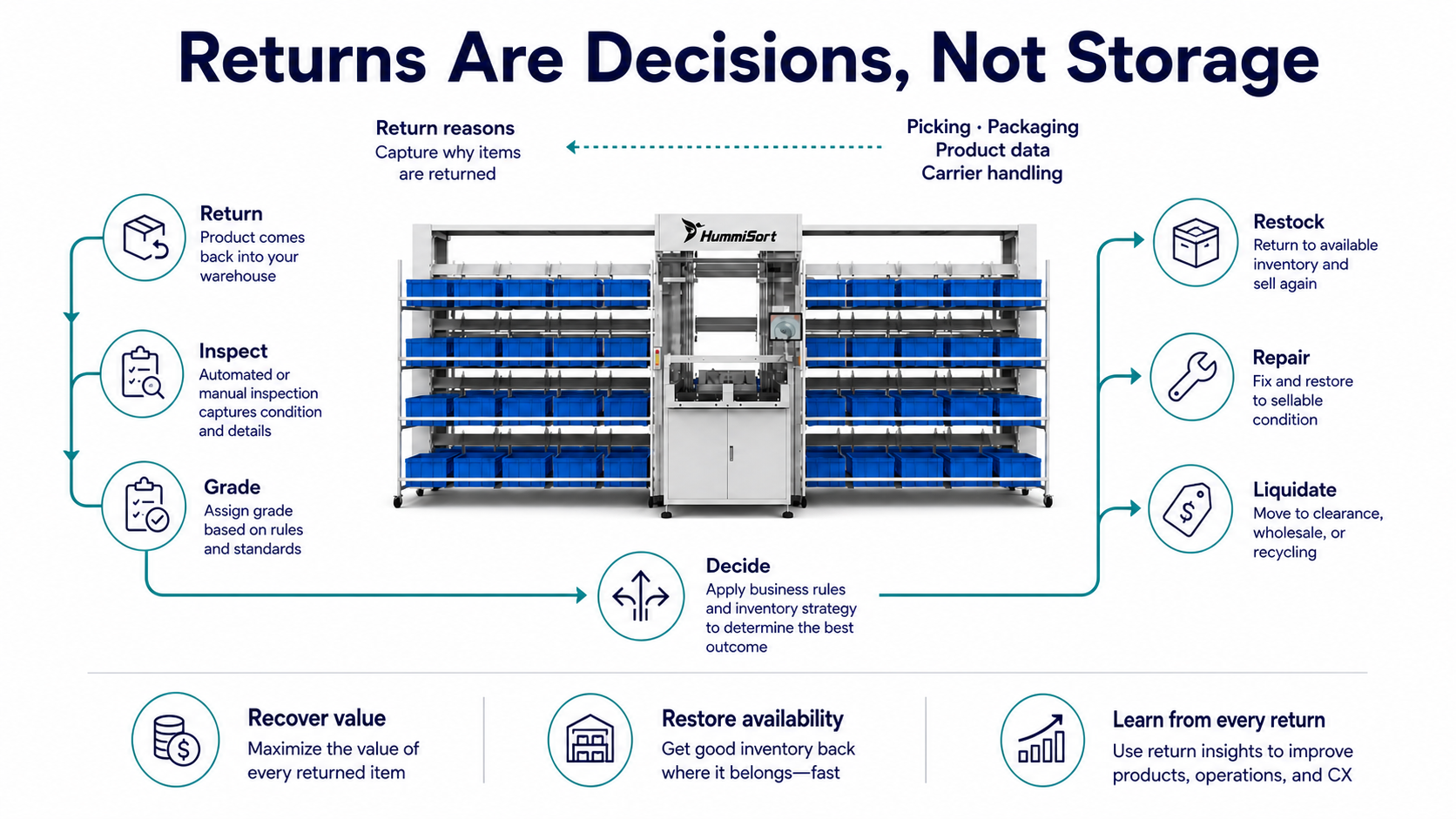
A returned item may be sellable and ready to restock, opened but recoverable, damaged and needing repair, incomplete or suspicious, or better suited for liquidation or recycling.
- Sellable: return to available inventory quickly.
- Recoverable: repackage, complete or perform light rework.
- Repairable: assign the next owner and repair process.
- Incomplete or suspicious: isolate and investigate.
- Unsellable: liquidate, wholesale or recycle.
When every return enters the same area
Inventory stops being an asset and becomes a queue. The longer an item remains unavailable, the harder it is to recover its value and maintain accurate inventory visibility.
Turn every return into a traceable decision
Strong reverse logistics operations make four things visible: why the item came back, what condition it is in, who owns the next decision, and when it becomes available again.
Learn from every return
Return reasons can reveal problems in product information, packaging, picking accuracy, carrier handling and customer expectations. Reverse logistics is both a value-recovery process and a feedback system for the entire fulfilment operation.
How long does a returned item stay unavailable?
If the answer depends on manual searching or a growing returns area, the real issue may be decision visibility rather than storage capacity.
Assess your returns sorting and disposition flow
Share your return volume, product profile, disposition rules and current systems to discuss a modular workflow.
Contact BDA Technology