
More automation does not automatically create a smarter warehouse.
Many fulfilment operations already have a WMS, conveyors, scanners, sorters and manual workstations. Each component may perform well on its own, yet the order flow still breaks at the handoffs.
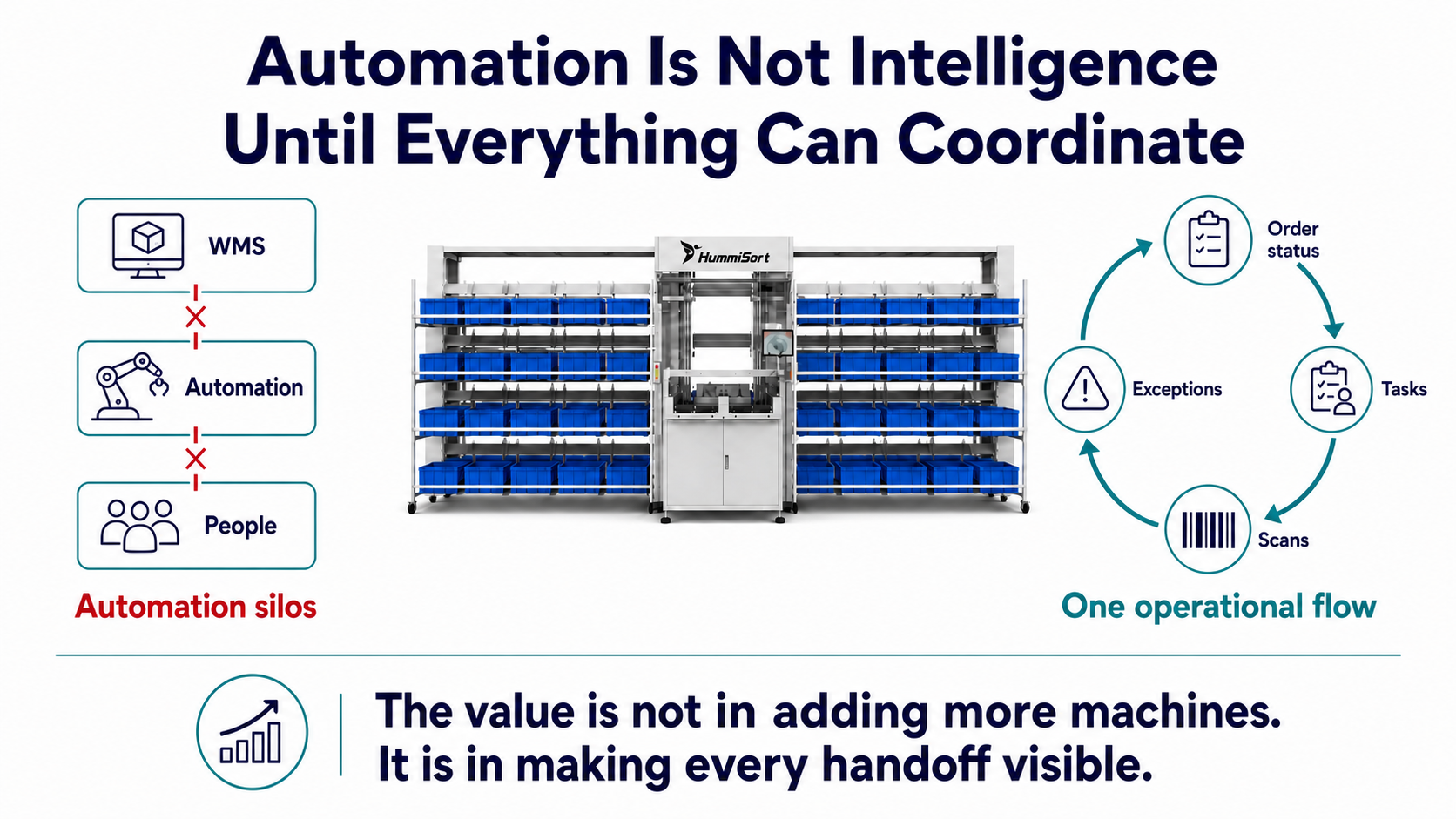
Automation silos appear at the handoffs
- The WMS shows one order status while the floor sees another
- A scan exception requires a supervisor to investigate manually
- One system completes its task, but the next team receives no clear instruction
- Routine exceptions are managed through spreadsheets, messages or personal experience
- A new tool adds another dashboard instead of better operational control
The problem is often orchestration, not a lack of equipment
A connected warehouse needs people, software and equipment to act from the same real-time operational picture, with a visible system record at every handoff.
People judge unusual cases; systems guide repeatable work
This does not mean every decision must be automated. People still need to make judgements in unusual situations. Repeatable work, however, should be guided consistently so the floor always understands the next action.
A put wall creates more value when it is part of the order flow
After batch picking, scan-guided consolidation can connect picked items, order status, put location and exception handling in one process. An automated put wall becomes more valuable when it supports that connected flow instead of operating as another isolated machine.
Warehouse automation should be measured by more than peak throughput. Ask whether people, software and equipment can act from the same real-time operational picture. The value is not in adding more machines, but in making every handoff visible, understandable and actionable.
Do your systems and equipment share the same real-time order status?
Connect HummiSort to the complete order flow
Evaluate every handoff from batch picking and scan-guided consolidation to exception handling.
Contact BDA Technology