
A missed carrier cutoff rarely starts at the loading dock. By the time the carrier arrives, the warehouse is often trying to solve a problem created by the morning plan and the upstream flow.
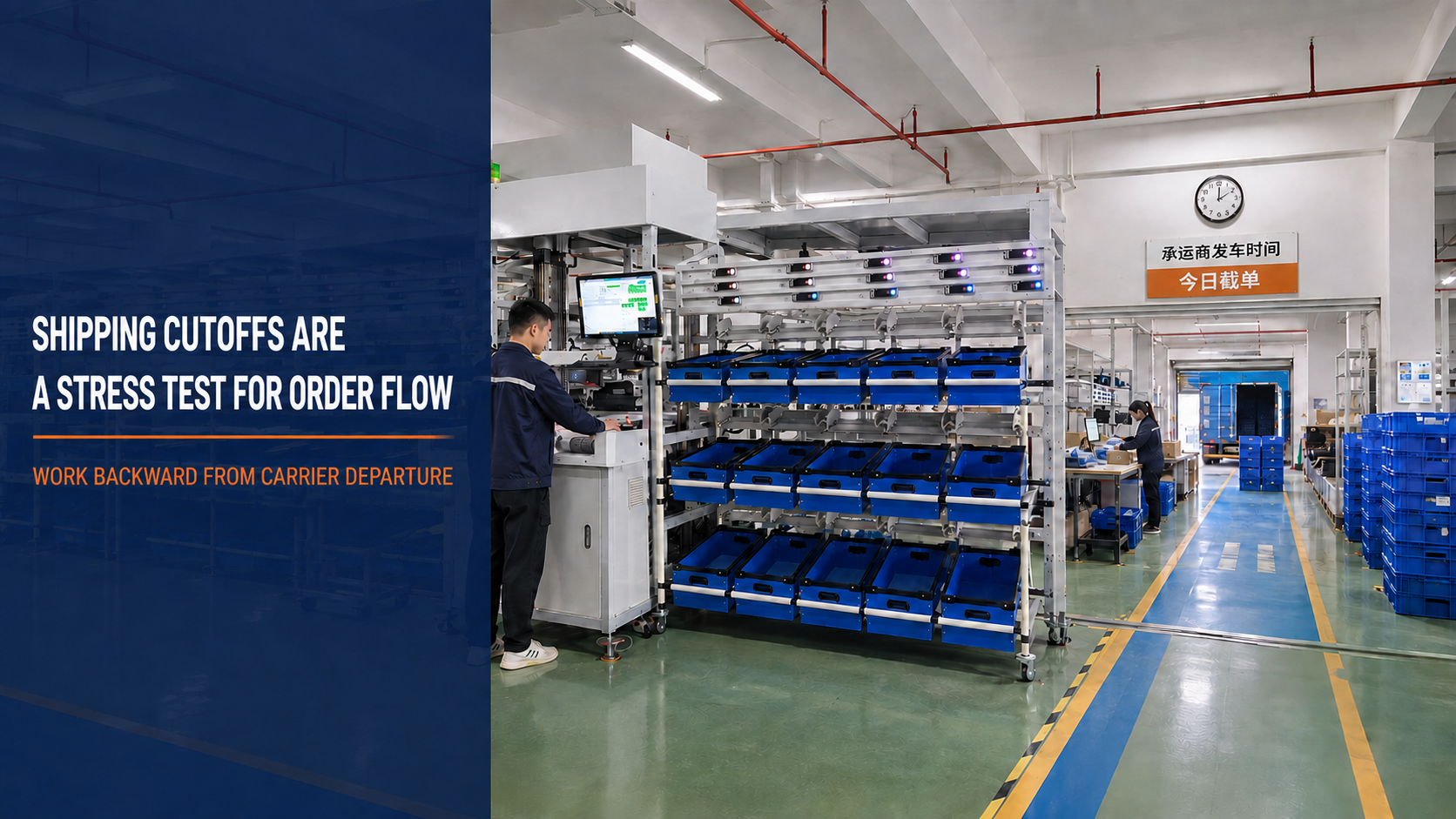
The problem usually starts hours earlier
Receiving may finish late, too much work may be released into picking, consolidation may accumulate, and packing capacity may become overloaded. Each delay consumes part of the final buffer.
- Late receiving compresses every downstream window
- Excess work release pushes congestion into picking and consolidation
- Consolidation queues prevent orders from reaching packing
- Overloaded packing eliminates the final dispatch buffer
Work backward from departure
A shipping cutoff should be treated as an operating constraint, not as a last-minute shipping task. Ask when the order must be loaded, when packing must be complete, when consolidation must finish, and when picking must release the work.
Align waves, staffing, staging, and exceptions
Backward planning changes how the operation manages waves, staffing, staging, and exception orders. Scan-guided consolidation can shorten the uncertain gap between picking and packing, while the larger objective is to make the entire order flow respond to a clear departure constraint.
Make the cutoff a manageable operating constraint
BDAITEC HummiSort combines scan-guided consolidation with automated put-wall sorting to help eCommerce and 3PL warehouses reduce queues and move orders reliably toward packing and dispatch.
Talk to us